Environment and supply chain
Stone, supply chain and waste
Natural stone is not consumed, is not replaced and, at the end of its life, does not become waste to be disposed of. So the question is not the material: it is how it is quarried, how it is cut, and what happens to what is left.
We can speak about this precisely, because we run the chain ourselves from the block to the finished piece. And for every element we deliver, we send the certificate.
From the block, with no middlemen
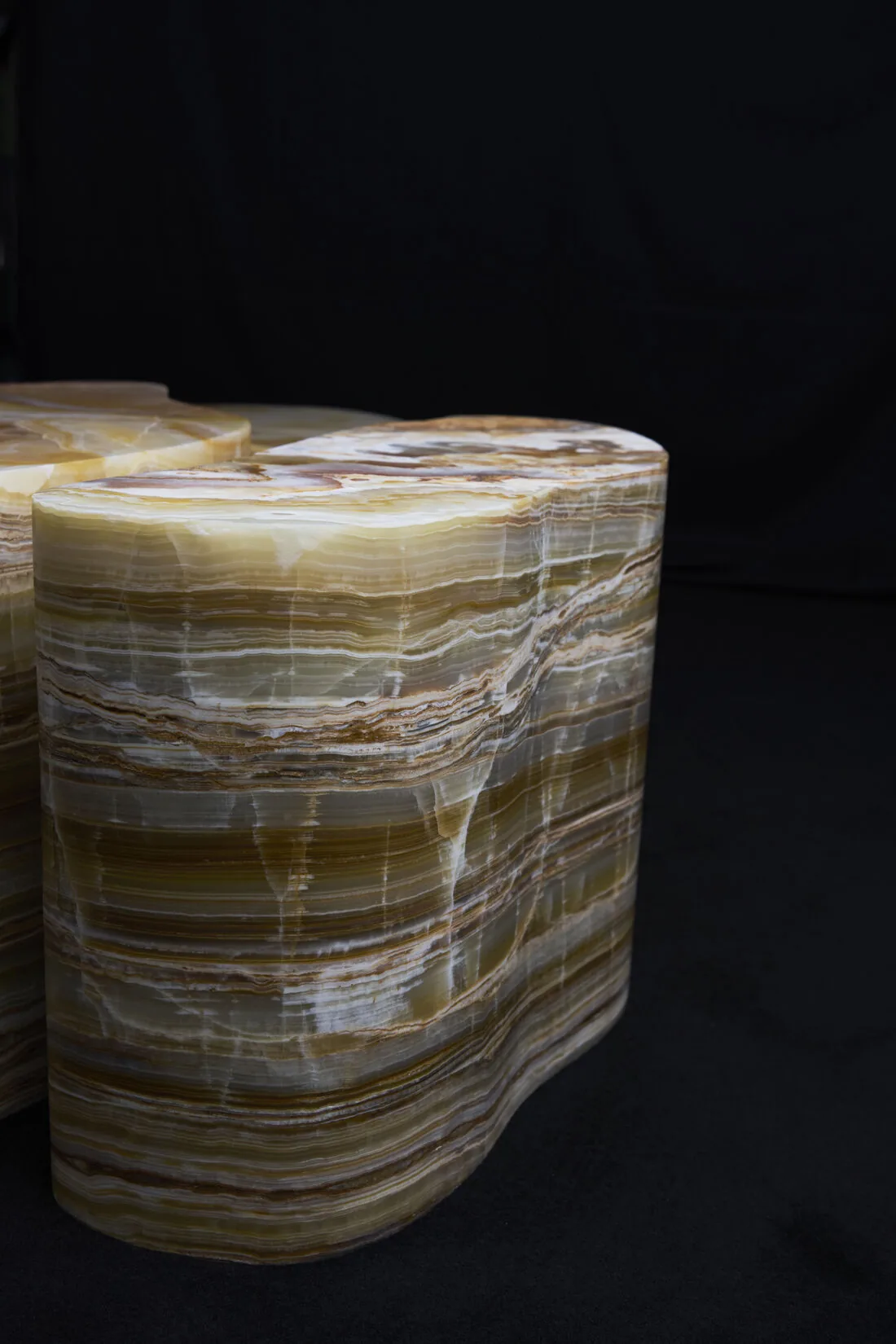
We buy blocks directly at the quarry and cut the slabs in our own workshops. Two marbles we produce ourselves, among them a beige called Daino Reale. All the others we buy at the quarry or at the sawmill from the actual producers, with no importer and no distributor.
This is our advantage on price. And it is the reason we can tell you where the stone we sell you comes from: between the block and the finished piece there is no step whose content we do not know.
Offcuts: where they actually end up
It is the part least often discussed, and for us it is the concrete one.
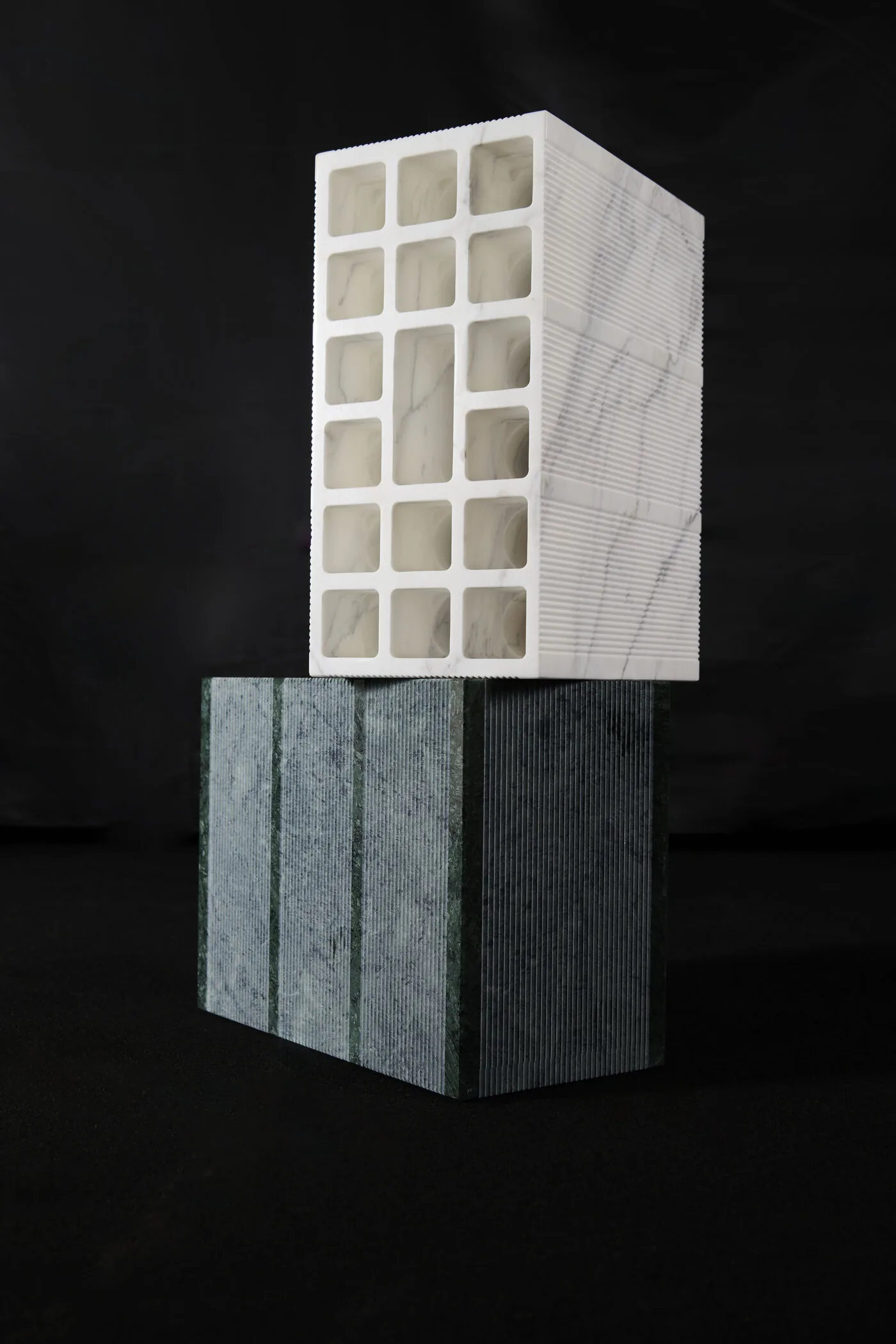
Processing waste is included in the quotation: the client pays nothing extra for it. Slab offcuts become smaller pieces that enter our collections. What is left is crushed and used in the aggregate for road sub-bases. From slab to sub-base, the material never leaves the cycle.
Then there is the way we cut, which is the simplest form of saving: because we hold the blocks, the client chooses the slab before production and indicates where the piece should be taken from, and for a uniform series we select the block closest to the client's brief. Cutting the right thing the first time is worth more than any recovery downstream.
Surface treatments, and the PFAS question
To protect surfaces we use PFAS free impregnating agents, based on silanes and siloxanes.
For the slab itself the answer depends on how the material comes in, and there are two distinct cases.
- When we buy the block, we cut the slabs ourselves and we do not treat them with PFAS: they are PFAS free because nobody put any on them.
- When we buy slabs already sawn, it is the supplier who certifies to us that the slab is PFAS free, and that certificate goes into the supply dossier.
We put it this way, separating the two cases, because it is a question careful specifiers ask and that almost always goes unanswered, or gets a single answer that does not cover every case.

Wooden parts
Where a stone top rests on a wooden structure, the rules of our furniture division apply: we buy traced, formaldehyde free timber only, the certificate travels with the product, adhesives are formaldehyde free, and the panel emission documentation inside the supply dossier. Since 6 August 2026 the European limit for furniture and wood-based articles has been 0.062 mg/m³ in a test chamber, and the burden of proof lies with the manufacturer.
Where we stand on certification, plainly
We have filed our application for PEFC certification and we are waiting for the certificate.
Until that day we do not display the mark. Forest certification marks belong to those who have passed the chain of custody audit, and a logo placed before the certificate is not an anticipation: it is a statement that the first documentary check takes apart. We would rather get there with the certificate number in hand and write it here.
The dossier that comes with the supply
- certificates of the individual elements, for every element supplied;
- name and origin of the stone, with the slab selection sent before production;
- data sheet of the treatments used, stating PFAS free, plus the supplier's PFAS free certificate where the slab was bought already sawn;
- formaldehyde emission documentation for wooden parts, where present;
- twenty-four month warranty, seven years on resin components.
Request a quotation The contract division
The regulatory references quoted are current at the date of publication of this page. The supply dossier is agreed with the client at order stage.