
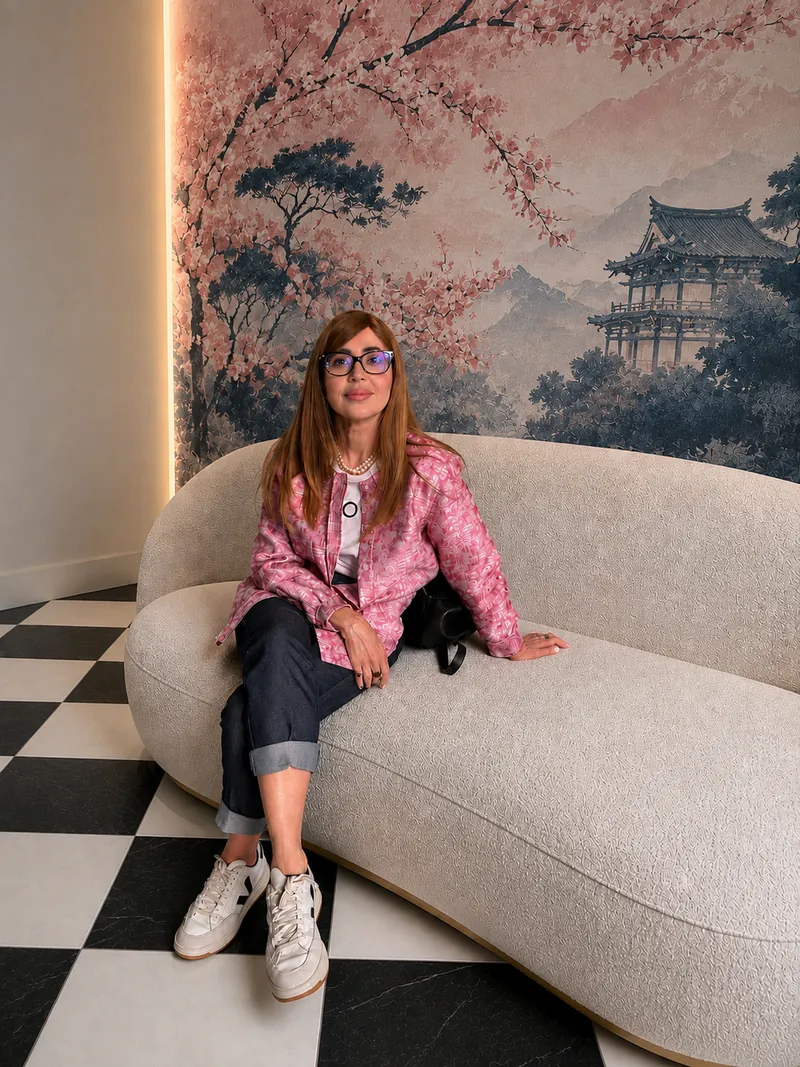
Creative Director
Silvia Gibertoni
Art, material and a personal vision of design
The path of the Creative Director of Stoneform and Brianform did not begin with a conventional training in design. It was built through different experiences — cultural institutions, the performing arts, opera and symphony foundations — until she met the material and the project.
Today Silvia Gibertoni brings to the two companies a personal way of seeing, in which art, fashion, culture and an eye for beauty meet the great Italian tradition of craftsmanship.
The interview
Your professional path began far from the world of design. What did you bring with you from those experiences?
I worked for many years in contexts very different from the one I am in today, but always close to culture, to the performing arts and to beauty. Those are experiences that taught me above all to observe.
I have never thought of my earlier path as something separate from what I do today. On the contrary, I believe that every experience builds a part of the way we see.
Fourteen years of classical ballet were also fundamental to my formation. Dance teaches rigour and discipline, but above all harmony, proportion and the relationship between body and space. They are ideas I find again and again in design.
How did the encounter with Stoneform and with marble come about?
It was first of all an encounter with the material.
Marble has something that is difficult to explain through its technical characteristics alone. It is an ancient material, natural and unrepeatable. Every slab carries a story that existed long before us.
What fascinates me is the possibility of starting from a material this powerful and giving it a contemporary language, without stripping it of its identity.
I am not interested in marble simply being precious. I am interested in what it can become.
The relationship between beauty and perception returns often in your vision. How much does neuroaesthetics interest you?
Enormously, because it asks a question I find fascinating: why do certain forms, certain colours, certain proportions or certain materials produce an emotion in us?
Beauty is not only decoration. Our brain responds to spaces, to light, to proportions, to colours, to material.
Neuroaesthetics studies precisely the relationship between aesthetic experience and the brain, and I believe it is an extremely interesting territory for anyone who works in design.
When I design, or take part in building an image, what interests me is always the sensation that thing will produce in whoever looks at it or lives with it. Before asking myself whether something is beautiful, I want to understand what it makes you feel.
What does being Creative Director of Stoneform mean to you?
It does not simply mean choosing a product or an image. It means building an identity.
I am interested in bringing different worlds into relation: marble with wood, metal, glass, leather; design with fashion; craftsmanship with contemporary research.
I believe strongly in contamination. Often it is precisely from the meeting of apparently distant elements that something new is born.
Part of my work is looking for those connections, recognising an intuition and turning it — together with the people who have the technical and artisanal skill — into something concrete.
How much does craftsmanship count in your work?
It is fundamental.
We can talk about design, technology and innovation, but in the end there are still the hands of someone who knows the material deeply.
Italian craftsmanship is an enormous heritage because it combines skill with the ability to interpret. The craftsman is not simply the one who executes: often he is the one who makes an idea possible.
That is why, for me, Made in Italy should not be only a geographical label. It is a way of working, made of knowledge, a culture of the material, attention to detail and the ability to make even what does not yet exist.
And then there is something I care about particularly: material must be able to be lived, not only represented.
Rendering today is an extraordinary tool for imagining what does not yet exist, and naturally we use it too. But Stoneform does not exist through images alone.
In our showroom in the heart of Brianza, in Cantù, you can come into real contact with what we do: see the marble, touch it, look closely at its veining, compare and choose the stones, and also see and touch the pieces we have already made and understand concretely how they are worked.
Because marble is not only colour and veining. The same stone can give completely different sensations depending on how its surface is worked: it can be smooth and polished, matt, brushed, bush-hammered, or take on a more textured quality. These are differences a photograph or a rendering can show only in part. You have to run a hand over them to understand them properly.
And that is exactly what our showroom makes possible: not only seeing what we make, but touching the material, comparing the finishes and understanding how a project is turned into something real.
Stoneform works a great deal on bespoke pieces. Is that also a way of understanding luxury?
Absolutely. For me luxury is not something that becomes fashionable, is replicated and ends up being the same for everyone. Luxury is above all uniqueness.
I think of haute couture. The real privilege is not wearing a garment produced in series, however exclusive it may be, but having the possibility that the designer of a maison creates a garment for you, on your proportions, your personality, your way of being. That garment is born for you, and it is yours alone.
In design, for me, the same thing should happen. A piece of furniture does not necessarily have to be born to be replicated endlessly: it can be conceived for one person, for one precise space, choosing its proportions, its materials, its finishes and every detail.
With natural stone this idea becomes even stronger, because the material itself is unique: there will never be two perfectly identical slabs.
That is my idea of luxury: not owning what everyone has, but something that was thought, drawn and made for you.
Is there a rule you follow when you choose something?
I try never to start from the trend.
Naturally I look a great deal at what is happening in fashion, in art, in architecture and in design. But a trend only interests me when it can be interpreted.
I prefer an object with personality — imperfect or unexpected, even — to something impeccable that leaves no sensation behind.
I believe identity is born exactly from that: looking at what happens around us without losing your own way of seeing.
And today, what would you like to tell through Stoneform?
I would like to tell of an ancient material without making it seem old.
I would like Stoneform to keep the culture and the skill that belong to the great Italian tradition of stone working, and always to have the courage to look further: to fashion, to art, to new materials, to new languages and to new creative generations.
Because I believe tradition truly has value when it does not become nostalgia, but becomes the point from which to build something new.
A thought attributed to Bernard of Chartres, the twelfth-century French philosopher, often comes back to me: «we are like dwarfs on the shoulders of giants». We can see further not because we are greater than those who came before us, but because we can climb onto the shoulders of those who, before us, built knowledge, experience and beauty.
I find that in design it is exactly like this. We do not have to free ourselves of what we have inherited in order to be contemporary: we have to know it, make it our own, and have the courage to carry it further.
«This, for me, is the future: having roots deep enough to let us see further.»